

Smashed art & the sharp pieces that remain
Oddly meaningful

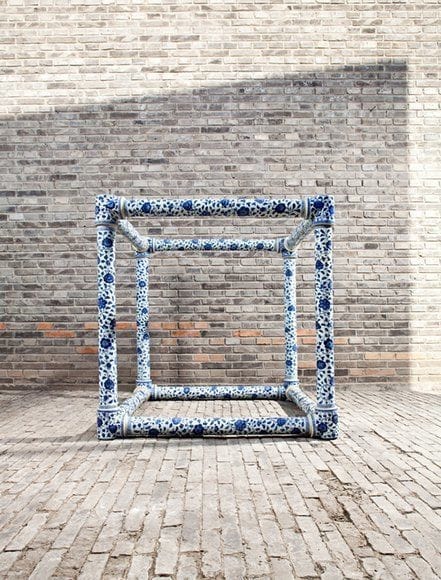
This week I fell down an internet rabbit hole or maybe worked through a Russian doll of smashed artwork stories. It started with reading about Ai Weiwei who while exhibiting in Italy, had his sculpture ‘Porcelain Cube’ smashed to pieces by a well-known art destroyer. I thought well that is tragic, who could be so destructive? But turns out I didn’t know very much about the vandalism of art. The Mona Lisa has been spray painted, Van Goghs sunflowers has had soup thrown at it, a Picasso mural was tagged, a Rembrandt slashed, Duchamps upside down urinal was used for its original purpose, a Mondrian was deliberately vomited on….. all in the name of activism. These people are nothing if not creative about their vandalism but unless the art can be recovered this might be the end for that piece.
Here is what Ai Weiwei's Porcelain Cube (2009) was:
Here is what it became this week:
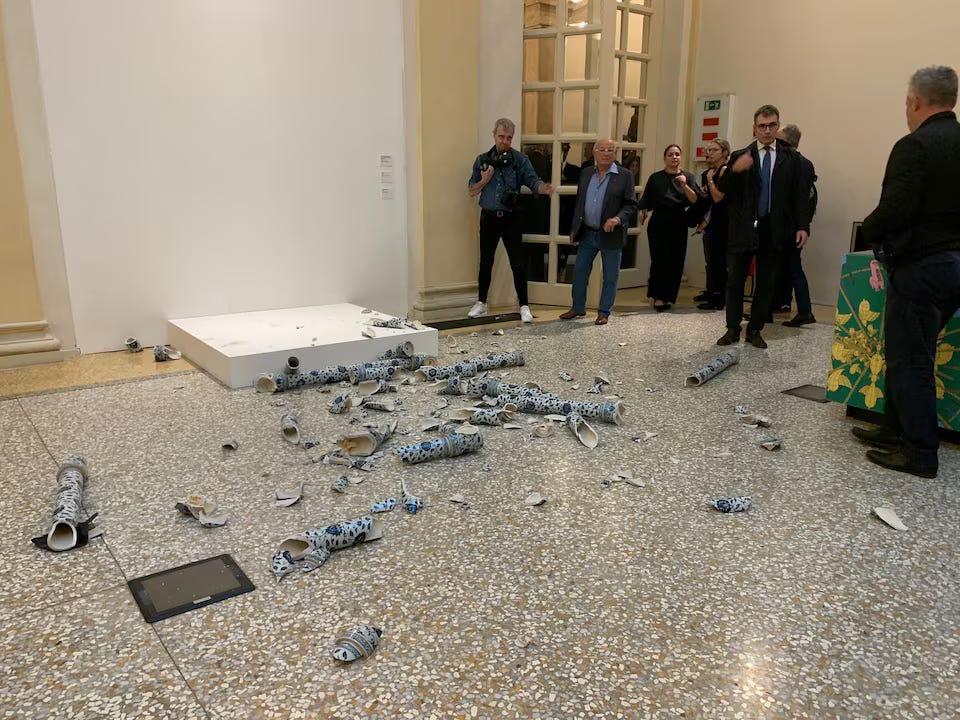
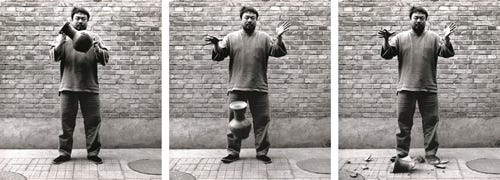
A pile of rubble. Interestingly the victim Ai Weiwei, is no stranger to controversy. His art is often an expression of his work as a human rights activist and believe it or not, he himself has destroyed art/artefacts in protest. After much researching I found that one reason Ai is famous, is for an artwork called “Dropping a Han Dynasty Urn”. This work consists of three photographs of Ai letting go of a 2000-year-old urn and causing it to smash. That urn was an artefact from the Han Dynasty and became an action described by Guggenheim Bilbao Museum as “equivalent to tossing away an entire inheritance of cultural meaning about China.” For Ai however, this performance was about questioning how and by whom cultural values are created.
In the interviews with Ai post ‘Porcelain Cube’ vandalism, his biggest issue was the threat to public safety, and he hasn’t put much emphasis on his destroyed artwork. This tracks in an article by Sam Gaskin where he said, “Last year, I asked Ai how his litany of losses and traumas impacted him. He said 'adversities and traumas stand as an inseparable part of life.” He continued, “'An individual dwelling in times of peace and ease is not necessarily exempt from experiencing trauma,' he went on. 'In fact, the very tranquility and comfort might be trauma itself.”
I might have to spend the next two years thinking about this sentiment (he also has a well-received book called 1000 Years of Joys & Sorrow which seems to elaborate on this quote), but it did remind me a lot of the duality in Kintsugi, or Kintsukuroi - the Japanese practice of fixing a broken piece of earthenware with gold instead of throwing it away. It’s an artistic way of making meaning from something terrible and to try and move on.
Anyway, the “Porcelain Cube” is sadly no more, Ai has said he won’t recreate it and thus that cycle has been broken. You can now see only a print of it in its place which is not quite the same.
‘Design Sense and Sustainability’ brings insights, essays, and guidance about design and designers from me, a freelance designer, writer, and researcher. There are no ads, no sponsors. Please support the continuation of my work (that I love!) by subscribing:
Thanks for reading! If you would like to check out some of my other creations:
Online Learning for Substackers: How to make a SubStack logo using Canva
Join my family’s Kimchilary Book Club here